



When considering an autologous hair transplant to address baldness, one of the biggest concerns is not just the technology or the clinic, but the number of grafts required. The number of hair grafts directly affects the density of the transplanted hair and the total cost of the procedure. If you are wondering, “How many hair grafts do I need to cover the bald area aesthetically while still being cost-effective?”, this article will provide a detailed answer to that question.
How many grafts do I need?
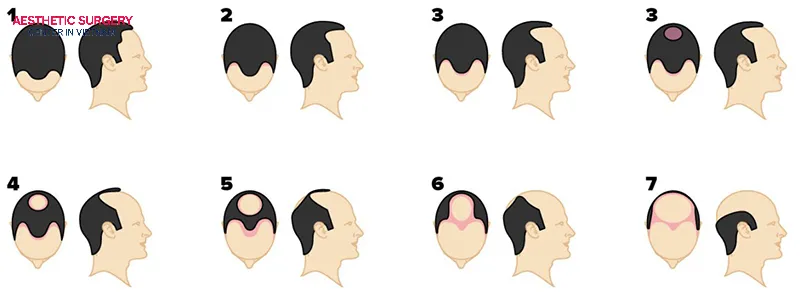
The number of hair grafts required is not the same for everyone. It depends entirely on the degree of hair loss, the size of the bald area, and the desired hair density. To determine the exact number of grafts needed, specialists usually use the Norwood Scale – the gold standard for diagnosing the severity of hair loss in men.
Below is a detailed analysis of each stage to achieve a natural and full head of hair:
Stage 1: 0–1,000 grafts
On the Norwood scale, Stage 1 is considered normal with no signs of baldness. However, if you are concerned about hair loss, you can use topical or oral treatments, or PRP hair therapy to maintain hair density. Additionally, if hair loss is stable, 0–1,000 grafts can be transplanted to reshape the hairline.
Stage 2: 1,000–1,500 grafts
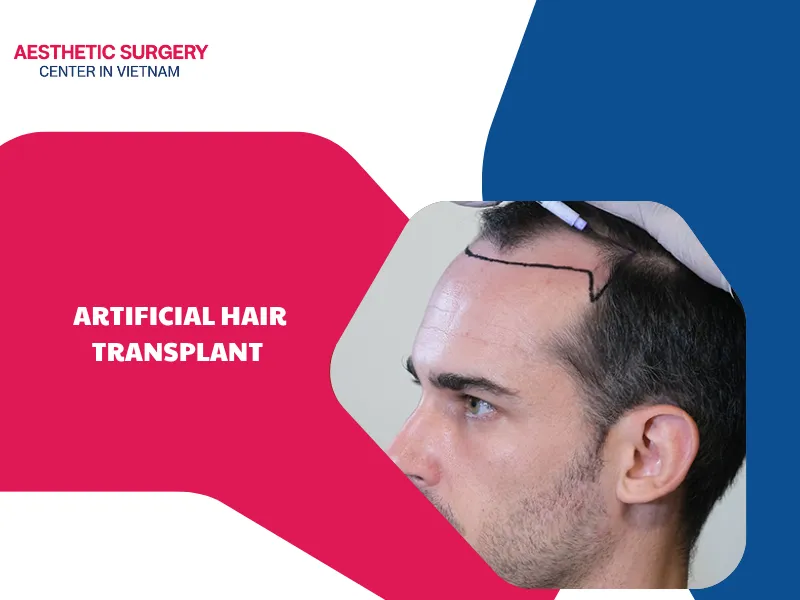
At this stage, the hairline begins to slightly recede, forming an M-shape but not too deep. Hair at the temples starts thinning. This is an ideal time for a hair transplant to “preserve” a youthful appearance. The number of grafts needed usually ranges from 1,000 to 1,500. You can also continue topical/oral treatments or PRP therapy to restore hair.
Stage 3: About 2,000–3,000 grafts
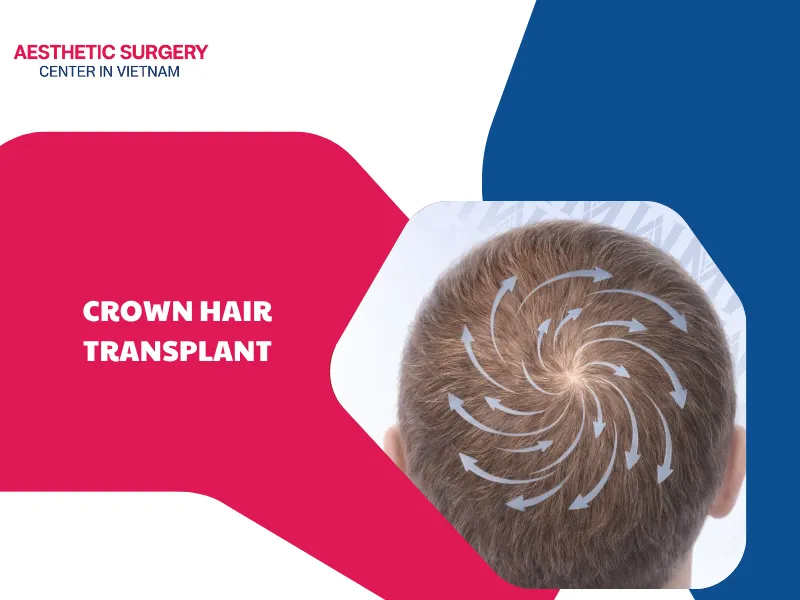
This is considered the lowest level of baldness that is recognized as true “balding” cosmetically. The hairline recedes further, forming a clear M-shape or U-shape. Additionally, even if the hairline is still intact, hair may start thinning at the crown, forming small bald patches.
At Stage 3, topical or oral treatments cannot restore hair. For a hair transplant at this stage, around 1,500–2,000 grafts are needed for the frontal area to create a thick and natural hairline, while 500–1,000 grafts are needed for the crown to achieve coverage. The total number of grafts for Stage 3 is approximately 2,500–3,000. Topical/oral treatments and PRP therapy can also be used to protect existing hair and support the growth of transplanted hair.
Stage 4: 3,000–3,500 grafts
At this stage, bald areas on the frontal region and the crown expand significantly. However, a thin strip of hair (bridge) still separates the two areas. If hair loss at the crown is not severe, the hairline may form a deeper U-shape. To restore a full look, at least 3,000–4,000 grafts are needed. The surgeon must carefully distribute the density to ensure natural coverage in both the frontal and crown areas.
Stage 5: 3,500–4,500 grafts
This stage is considered advanced baldness. The strip of hair separating the frontal and crown areas (still visible in Stage 4) becomes very thin and sparse, almost broken. Bald areas on the frontal and crown regions begin to merge. Large bald patches occupy most of the crown, with hair remaining mainly at the back of the head and sides. Restoring hair at this stage requires approximately 3,500–4,500 grafts. surgeons usually prioritize denser transplantation at the front for aesthetic appearance, while maintaining moderate density at the crown to conserve grafts.
Stage 6: 5,000–7,000+ grafts
This stage is considered severe baldness. The entire frontal area, crown, and bridge are completely bald, with all bald areas connected. Hair remains only in a horseshoe shape around the back of the head and sides. The number of grafts usually needed at this stage is 5,000–7,000. Due to the large number, transplantation is often done in two sessions rather than one.
Stage 7: Over 7,000 grafts
This stage represents extreme male baldness. Only a few thin, weak hairs remain, mainly at the temples, while the entire crown is completely bald. To achieve full coverage, at least 7,000 grafts are required. However, very few people undergo this procedure because it is difficult to fully restore thick hair, it is costly, and it carries significant risks.
How many hair grafts does the average person have for a hair transplant?
On average, a person needs about 4,000–6,000 grafts that can be transplanted from the donor area. However, this number can vary depending on the individual, as the available grafts are limited by the donor area. Taking too many grafts can lead to aesthetic issues and contribute to potential hair transplant risks, such as affecting the uniformity and density of both the donor and transplanted areas. To determine the exact number of grafts needed and ensure a safe, natural-looking result, it’s best to consult with experienced surgeons at a reputable clinic.
How are the extracted grafts allocated for hair transplant?
Allocating grafts is a “visual trick” technique. Since the donor area (back of the head) has a limited number of hairs, surgeons cannot densely transplant evenly across a large bald area. Instead, they apply a “priority allocation” strategy based on the type of graft (single-hair or multi-hair grafts). Surgeons also consider factors such as facial structure, aesthetic goals, and the patient’s natural hairline.
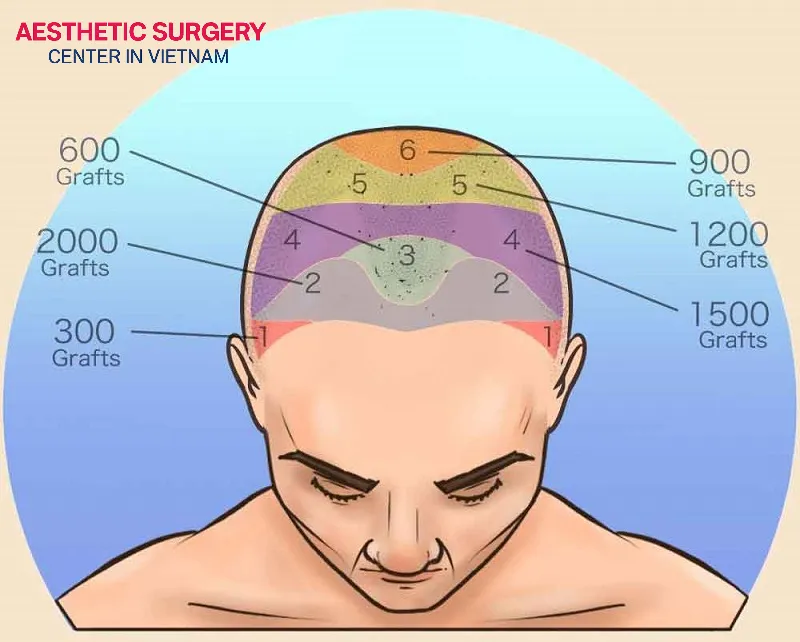
Typically, surgeons allocate hair grafts across the scalp as follows:
- Hairline area: 500–800 grafts, covering 20–30 cm²
- Forehead area: 1,000–1,500 grafts, covering 30–40 cm²
- Mid-scalp area: 800–1,200 grafts, covering approximately 40–50 cm²
- Crown and vertex area: 1,500–2,500 grafts, covering 60–80 cm²
What are the treatment options?
Hair loss and baldness in men have been studied by experts and surgeons, who have developed different treatment methods. Depending on the condition, personal needs, and budget, patients can consider the following options to help hair regrow faster:
Medication
Today, there are several medications for male hair loss designed to strengthen weak hair follicles and prevent further hair loss. This solution is popular because it is convenient, non-invasive, lower in cost compared to other methods, and easy to use at home. However, not all medications deliver the expected results. The two most common types of hair loss medications are:
- Topical Minoxidil: Dilates blood vessels around hair follicles, increasing nutrient and oxygen supply to the follicles and prolonging the growth phase (Anagen).
- Oral Finasteride/Dutasteride: Inhibits the enzyme 5-alpha-reductase, preventing the conversion of testosterone into DHT (Dihydrotestosterone) – the main cause of follicle shrinkage in men.
Medication works best for early-stage hair loss, thinning hair, or follicles that are not completely dead. Continuous use for 3–6 months is needed to see visible results.

PRP therapy
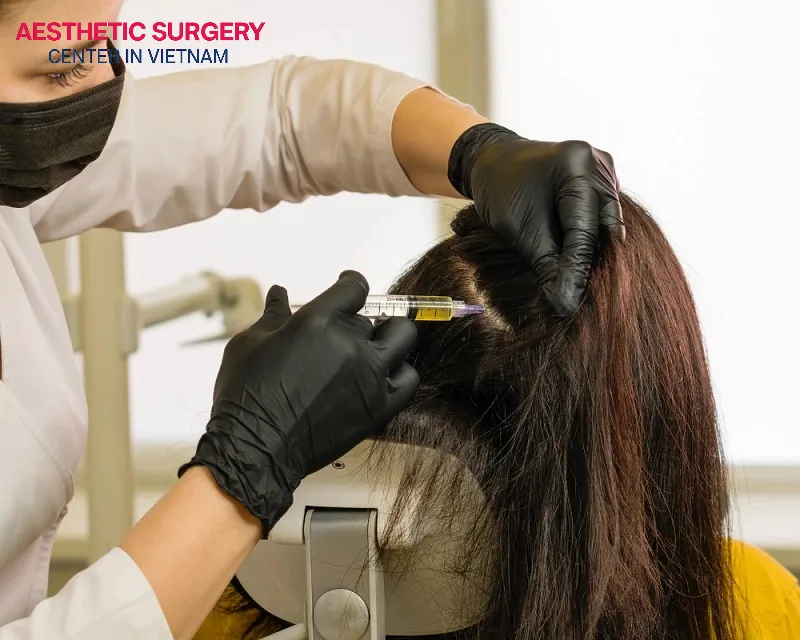
PRP (Platelet-Rich Plasma) is a semi-invasive method that uses the patient’s own blood to restore hair follicles. About 20–30ml of blood is taken, then spun in a centrifuge to separate the plasma with platelet concentrations 3–5 times higher than normal. This plasma is then injected directly into the scalp. Growth factors in the platelets stimulate cell regeneration, promote blood vessel formation, and “wake up” dormant hair follicles. This method helps hair strands become thicker, stronger, and reduces breakage and shedding. A full course usually requires 3–5 sessions.
The advantages of PRP therapy are its absolute safety, no risk of irritation or rejection, and quick results. While often utilized to accelerate hair transplant recovery, the procedure can be quite painful during injection, is relatively costly, and remains ineffective for areas that are completely bald.
Hair transplant
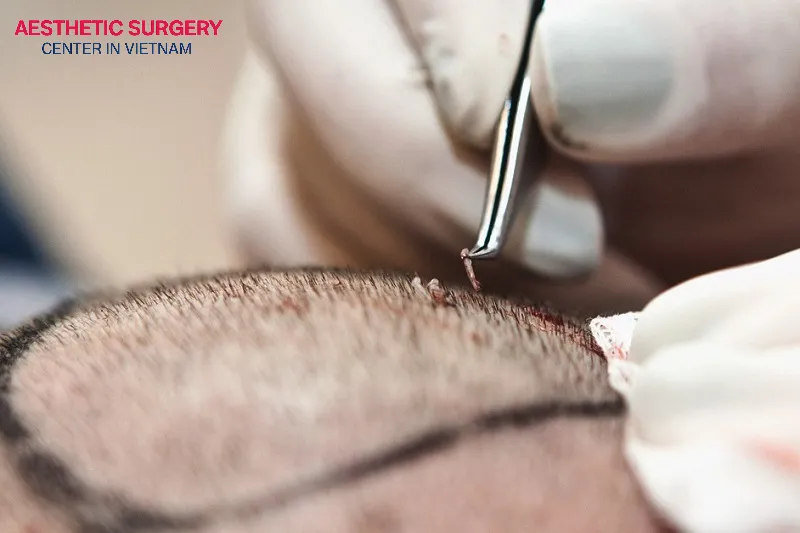
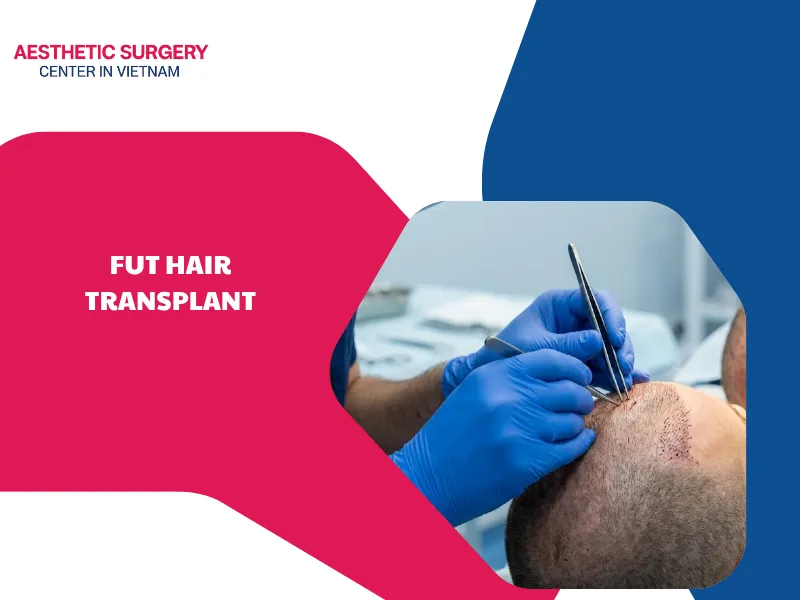
This is currently the most effective and only method to treat baldness by “reviving” hair in areas where follicles have completely died. The procedure involves moving healthy hair follicles from the donor area at the back of the head to the bald area. Because a hair transplant is permanent, the results provide a lifelong solution where the transplanted hair acts as real hair, growing and shedding naturally in its usual cycles.
The advantages of a hair transplant include fully resolving baldness, lowering a high hairline, achieving natural-looking hair, and allowing styling such as curling, coloring, and trimming. However, the drawbacks include a significant hair transplant cost, the invasive nature of the surgery, the required downtime, and the procedure’s dependence on the quality of the donor area.
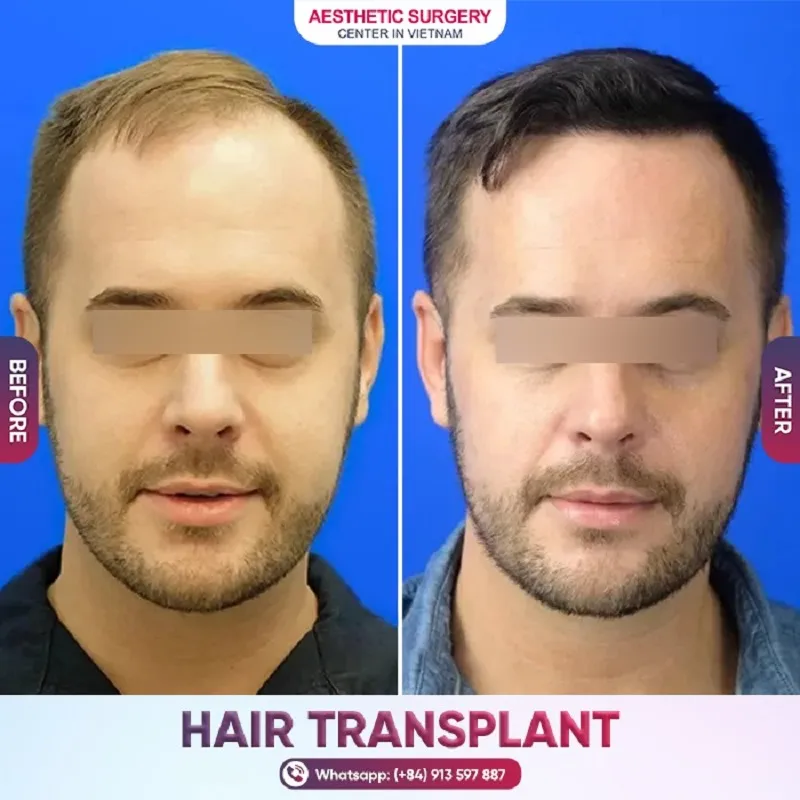
After answering the question “How many hair grafts do I need?”, you should now have a clear idea and have gathered additional related information. We hope this article has provided you with useful insights. If you want a more in-depth understanding of the number of grafts required, consult an experienced hair transplant specialist.














Comment on the post